
gentleendo.com
Prepared for Dr. Nivine Y. El-Refai, BDS, DDS, MSD, Gentle Endodontics. A look at how well the current website loads, how easily search engines and AI assistants can read it, and what it tells a patient in the first few seconds. We finish with a concept, revised after our conversations of September 29 and October 5, of what a faster, clearer site in your own colors could look like.
Overall
C−
Great credentials, hidden
Luke Scott
Executive Vice President, Dental TI
David Hanning
CEO, Dental TI
The short version
You bring a great deal that patients should see right away: board certification, teaching endodontic residents at Case Western Reserve since 2000, research published in the Journal of Endodontics, a Fellowship in the International College of Dentists, your term as President of the Ohio Association of Endodontists, GentleWave, your own 3D imaging, and 25 years of saving teeth. Your current site already holds much of this, and it reflects real care in what you chose to share. The opportunity is to bring it forward, so a first-time visitor sees it in the first few seconds rather than after the rotating photo at the top.
Underneath, the site is slow on phones, has no structured data at all, turns away many automated visitors, often including AI assistants, before they can read a word, and shows every visitor a Reviews page with zero stars. None of this is hard to fix, and the concept rebuild below fixes all of it.
Open the concept siteWhat the current site gets right
Clear, local page titles
Every page has its own title naming the procedure and "Medina OH", and its own description. That is the foundation of local search, and it is done well.
Real depth of patient education
Root canal myths, safety, cracked teeth, trauma and regenerative endodontics: more useful material than most specialist sites carry.
Genuine photography exists
There are warm, real photos of you at the microscope, welcoming patients at the door, and a bright, calm office. They are simply not used where they matter.
Secure and consistent
HTTPS everywhere, self-referencing canonical tags, and a sitemap that lists the main pages.
Scorecard
Measured on September 29, 2026: a crawl of all 51 pages in your sitemap, Lighthouse runs on four key pages, and a review of what each page shows first.
Speed on phones
Mobile performance scores of 51 to 72. The main image takes up to 18.6 seconds to appear on the GentleWave page, and the homepage shifts as it loads (layout shift 0.42, where anything over 0.25 is poor). Pages weigh 2.7 to 3.8 MB and make 70 to 106 requests.
Concept: Mobile performance 99 to 100 on every page tested. The main image appears in 1.7 to 2.1 seconds instead of 5.6 to 18.6 seconds, with no layout shift and pages a fraction of the weight.
Crawlability and AI assistants
A bot challenge sits in front of every page. Anything that is not a full web browser receives an "Attention Required" block, even for robots.txt and the sitemap. Google and Bing are normally let through, but AI assistants, link previews in text messages, and most SEO tools often are not. The llms.txt file for AI assistants is empty, and robots.txt fails validation.
Concept: Open to search engines and AI assistants, a valid robots.txt that welcomes them, and a complete llms.txt describing the practice, the doctor and every treatment.
Structured data and local search
None of the 51 pages carries structured data. Search engines are never told, in their own format, that this is a dental specialty practice, where it is, when it is open, who the doctor is, or what she is certified in. The FAQ pages have no FAQ markup.
Concept: Practice, doctor, procedure, breadcrumb and FAQ markup on every page, with address, hours, board certification and memberships, all generated from one facts file so it never drifts.
Trust in the first screen
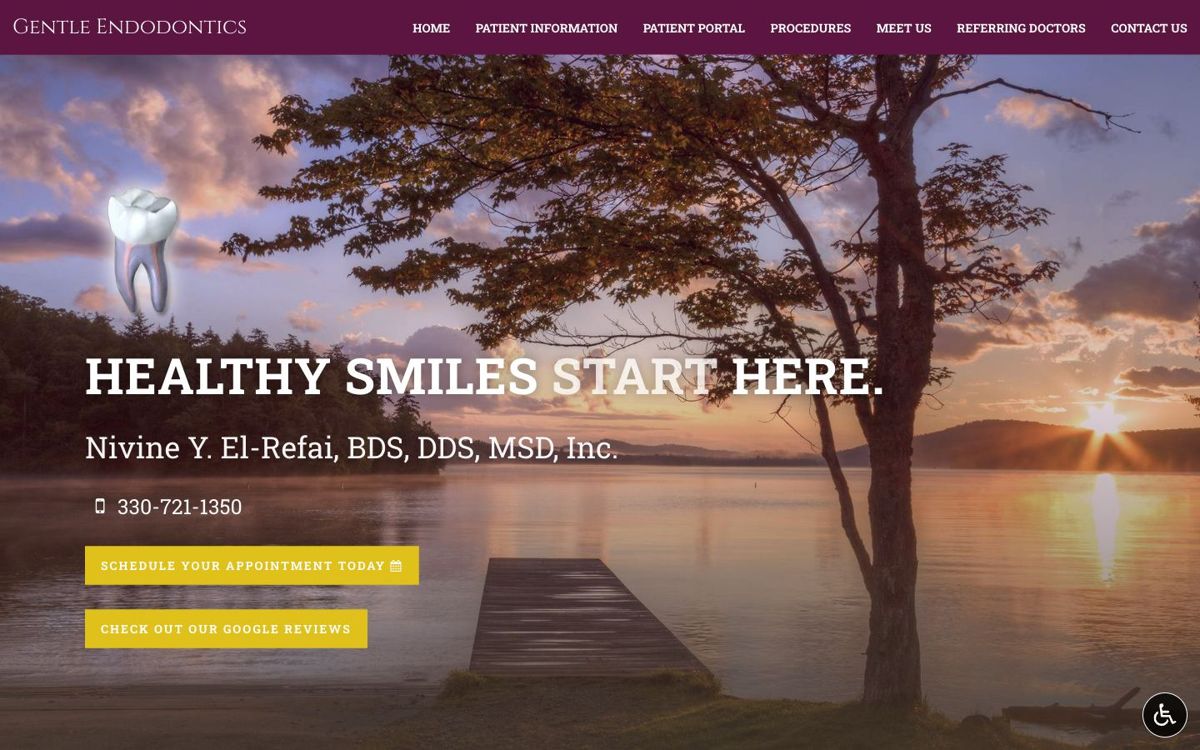
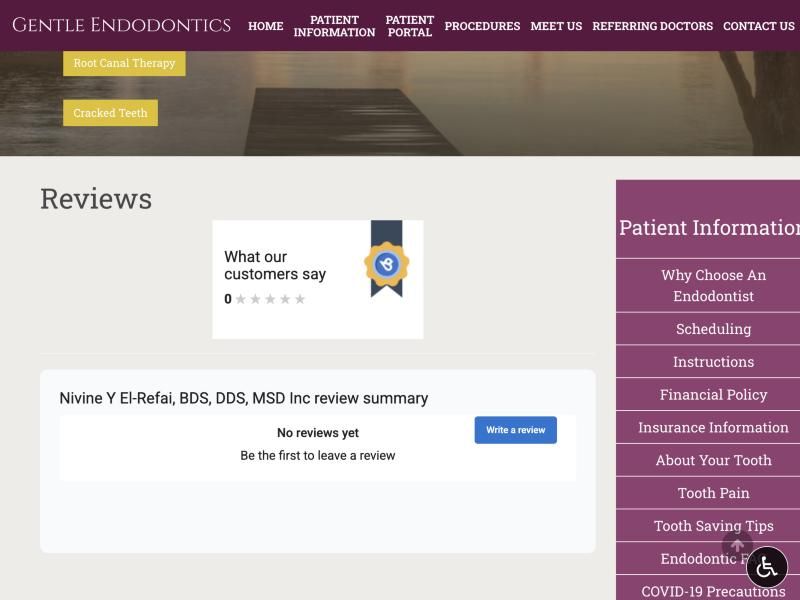
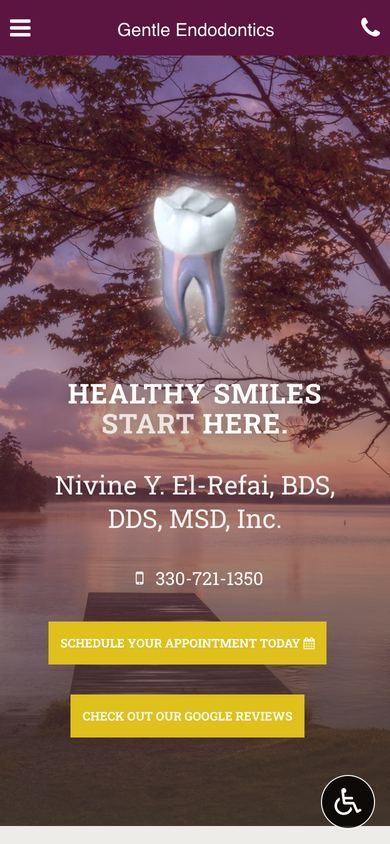
Every page opens with a stock sunset and "Healthy smiles start here", a general-dentistry line. Apart from the word "Endodontics" in the logo, nothing in the first screen says you are a root canal specialist or board certified; certification appears only inside the education list on your bio. The Reviews page tells visitors "0" and "No reviews yet".
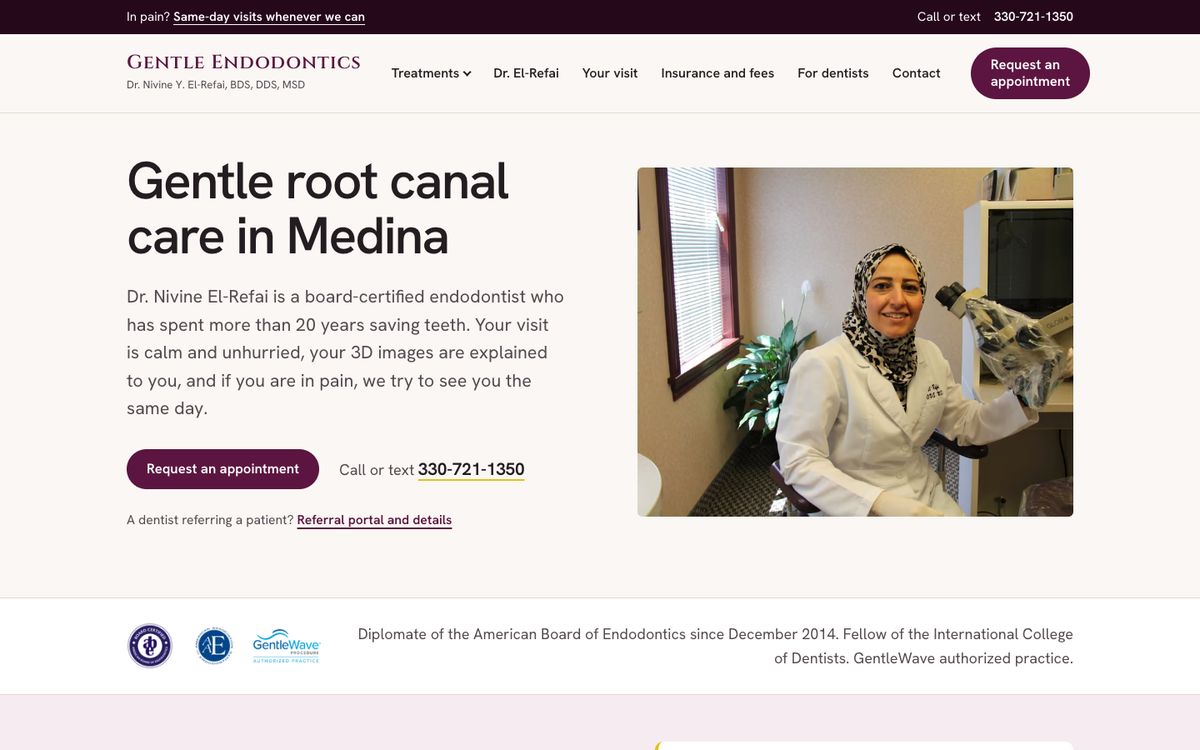
Concept: A calm, welcoming first screen, "board-certified endodontist" in the opening sentence, your 4.9 Google rating from 289 reviews beside the headline and linked to your Google profile, and your board certification, faculty title, published research and Ohio Association of Endodontists presidency just below, each with a link to the proof.
Content quality
Plenty of pages, but much of the copy is generic or supplied by manufacturers ("With the Veraview X800, MORITA has redefined top-class X-ray combination systems"). Template phrases slip through: "the doctors will reopen your tooth" on a solo practice. Several menu pages are nearly empty: Instructions has 8 words, Meet Us 39, Procedures 90.
Concept: 51 thin pages folded into 19 complete ones, written in plain language about your practice, with every old address forwarding to its new page.
Technical health
19 to 20 scripts and 24 stylesheets on every page, including two versions of Bootstrap and three icon fonts. Three sitemap entries redirect elsewhere, one page has no main heading and another has two, and the bare domain takes two redirects to reach the site. Best practices scores of 57 to 81.
Concept: Best practices 100 on every page, with 5 to 12 requests per page instead of 70 to 106. One heading per page, a clean sitemap, and an automatic check that blocks mistakes before they go live.
Privacy
The contact form asks which procedure a visitor needs and offers a free-text comments box, on pages that load a Google Tag Manager container. There is no way for a visitor to opt out of tracking.
Concept: A contact-only request form, analytics with advertising features off, and a one-click opt-out that honors browser privacy signals.
Accessibility
Lighthouse accessibility scores of 89 to 97. Remaining issues: some low-contrast text, links marked by color alone, and small tap targets.
Concept: Lighthouse accessibility 100 on every page, built to WCAG 2.2 AA.
Speed, measured the same way twice
Lighthouse 12.8 with simulated mobile throttling, three runs per page, median reported. The current site blocks headless test browsers, so it was measured in a standard Chrome window; the concept was measured in headless Chrome. Throttling is simulated in both cases, so the numbers compare fairly.
| Page | Mobile score | Main image on mobile | Layout shift | Best practices | Page weight | Requests |
|---|---|---|---|---|---|---|
| Home | 52 → 99 | 6.3 s → 2.1 s | 0.42 → 0.00 | 79 → 100 | 2.7 MB → 183 KB | 70 → 12 |
| Root canal | 51 → 100 | 6.5 s → 1.7 s | 0.31 → 0.00 | 57 → 100 | 3.8 MB → 101 KB | 106 → 5 |
| GentleWave | 57 → 100 | 18.6 s → 1.7 s | 0.00 → 0.00 | 75 → 100 | 3.5 MB → 95 KB | 89 → 5 |
| Contact | 72 → 99 | 5.6 s → 2.0 s | 0.00 → 0.00 | 79 → 100 | 2.8 MB → 163 KB | 84 → 6 |
Current: www.gentleendo.com. Concept: gentle-endodontics.pages.dev. Each cell shows current, then concept.
What visitors see today
A concept in your own colors
Revised after our October 5 conversation. It keeps your identity (the plum, the gold, the Cinzel wordmark), is organized around what you told us matters, and cuts the menu to five clear choices. The opening is a painted molar, cut open to show its canals: as a visitor scrolls, the inflamed red in the canals gives way to a clean white glow. The photos are your own: your office and its technology on the treatment, technology and visit pages, and you where the page is about you. The one exception is the aerial view of your building, shown on the contact page and faintly behind the homepage opening. It is a rendering made from public photos and map views, so please tell us if anything about it looks wrong. Small painted lake scenes, beside the call to action and faintly behind one homepage section, add a quiet touch of nature in the background, while your credentials and your care lead every page.
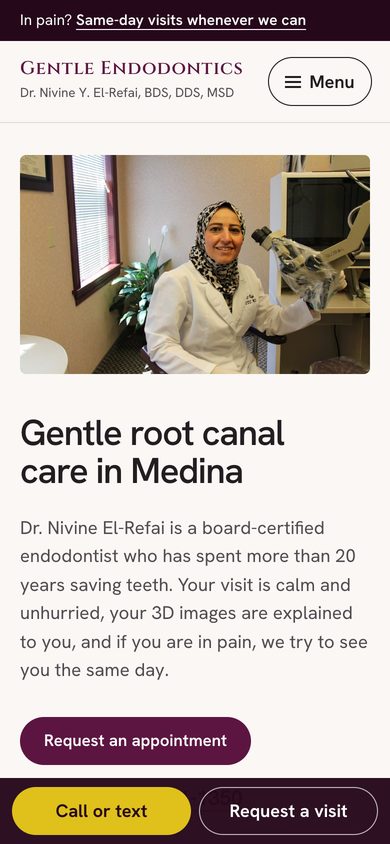
- Two front doors. Patients in pain get a same-day path and a call-or-text button; referring dentists get a direct route to your referral portal.
- Your reputation up front. Your 4.9 rating from 289 Google reviews sits in the opening section, under the molar on a computer and under the call to action on a phone, and opens your Google profile. A new reviews page shows the themes patients mention most, led by "thorough explanations", and can feature the reviews you choose on the treatment pages they describe.
- Credentials up front, with proof. Directly under the first screen: board certified since 2014, Clinical Assistant Professor at Case Western Reserve, four Journal of Endodontics papers, and President of the Ohio Association of Endodontists. Your bio page adds a timeline from Cairo University to today, every paper linked to PubMed, your honors, and each credential linked to its source.
- Your voice, and your practice’s. Your bio opens with a short note in your own words, drafted from our October 5 conversation for you to edit. The rest of the site speaks as your practice, and introduces Jennifer at the front desk.
- Seven complete treatment pages in place of dozens of thin ones, each with its own questions and answers marked up for search.
- Nothing useful left behind. Your before-and-after instructions, root canal questions and myths, surgery aftercare and tooth pain guide are all kept, rewritten in plain language and updated to how you practice today.
- Every old address still works. All 51 URLs from the current sitemap forward to their new pages, so search history carries over.
- Easy to keep current. Hours, insurance plans and team members each live in one simple file, with written instructions any AI assistant can follow.
What you told us, and where it shows up
"Loaded with information, hard to navigate"
You want it streamlined, fast, and in good standing with Google.
Concept: Five menu items instead of dozens, 19 complete pages instead of 51 thin ones, and pages whose main image appears in about 2 seconds on a phone.
"We care. They're not just a number."
Personal, one-on-one care is the first thing you want patients to know.
Concept: The opening line makes your personal involvement the promise, and a "Personal care, one on one" section follows directly after your credentials.
Personal care through every step, including the imaging
You take and analyze the 3D scan yourself and explain it, where others hand it to an assistant.
Concept: The opening sentence says you personally guide every step, from 3D imaging to the final visit, and your bio, the visit page and the root canal page carry it through.
One visit, and a permanent filling every time
Unhurried treatment, usually finished in one appointment, with no temporary fillings.
Concept: Both appear on the homepage and throughout the treatment pages, and for referring dentists.
Evidence-based technology
GentleWave and the CBCT, used because the evidence supports them.
Concept: Described in plain language, with the manufacturers' marketing copy replaced by what the research shows, cited on the page: 97% of teeth healed or healing at one year, and very little discomfort afterward.
Your credentials ahead of nature pictures
You liked the focus on your training and one-on-one care, compared with nature pictures.
Concept: A credentials section on the homepage and a full record on your bio: timeline, teaching, published research, honors and memberships, with each credential linked to its source in the sentence that states it.
Honest about the risks
You explain every risk on uncertain cases and take them on only when the chance of success is good, and you go through the scan slice by slice.
Concept: A new "Honest odds before you decide" point on the homepage, and the slice-by-slice scan review on the homepage, technology page and your bio.
No referral needed
Many of your patients find you by word of mouth, and they can book directly.
Concept: "No referral needed" sits under the first call to action, in the homepage's tooth-pain section and on your bio, and new articles cover the care word of mouth brings you: vital pulp therapy, cervical resorption and unexplained pain.
Your forms and referrals keep working
Your patient portal and referral portal both run in TDO, and TDO connects to any website through its secure login links. The concept keeps both links exactly as they are, so nothing changes for your team: patients still receive their registration code after scheduling, then complete and sign their forms and confirm their appointment online, and referring dentists still send referrals, images and follow reports in their portal.
What improves is how easy they are to find. A "Patient portal" link sits at the top of every page, a new page walks patients through the steps in order, and referring dentists see exactly what the portal lets them do and how to log in the first time.
Your domain and email stay yours
Moving to a new website changes only the website. Here is how your setup looks from the outside, as of September 29, 2026:
- Email is hosted by Rackspace, separately from the website. Changing websites does not touch it, as long as the existing email records are carried over exactly, which is a standard step in any move.
- The domain gentleendo.com is registered at Domain.com, where it has been since 2000. It renews on May 25, 2027. Make sure the login for that account is in your name.
- The website address records are managed in a Cloudflare account, which also runs the bot challenge described above. We would confirm who holds that account before any move.
- One gap to close: there is no DMARC record, a simple setting that stops others from sending email pretending to be you and helps your messages reach inboxes.
Your content and photos are yours too. Everything on your current pages can move to the new site, and the new site would live in accounts in your name.
Getting found for what patients search
People rarely search "endodontist". They search the question keeping them up at night. We collected the exact wording Google suggests for 40 root canal, tooth pain and local searches, checked what your pages already answer, and found where the gaps are.
Save it or pull it?
"root canal vs extraction", "root canal vs implant", "root canal or pull tooth"
New article: what long-term studies show. Root canal-treated teeth and single implants survive at similar rates.
Will it last, and do I need a crown?
"how long does a root canal last", "does a root canal need a crown", "how long before crown"
Two new articles: 97% of 1.4 million treated teeth were still in place at eight years, and teeth without crowns were lost at six times the rate.
Pain, antibiotics and relief
"does a root canal hurt", "antibiotics for tooth infection", "toothache relief"
Three new articles built on the ADA's 2019 antibiotic guideline and 2024 dental pain guideline, each pointing patients in pain to a same-day visit.
"But it doesn't hurt"
"why do I need a root canal if I have no pain", "cbct root canal"
New article: why infections can be silent, and why your 3D scan finds what a regular x-ray misses (regular x-rays caught about 55% of lesions in one study).
When a root canal fails
"root canal failed what next", "retreatment vs extraction", "apicoectomy vs root canal"
New article: retreatment, microsurgery (94% success in a meta-analysis) and extraction, compared honestly.
Questions a specialist answers best
"can a tooth nerve be saved", "cervical resorption", "tooth pain no cause", "why do root canals fail"
Four new articles from our October 5 call: who vital pulp therapy is for, cervical resorption, pain no one can explain, and the details that help a root canal last. Each figure was checked against its source.
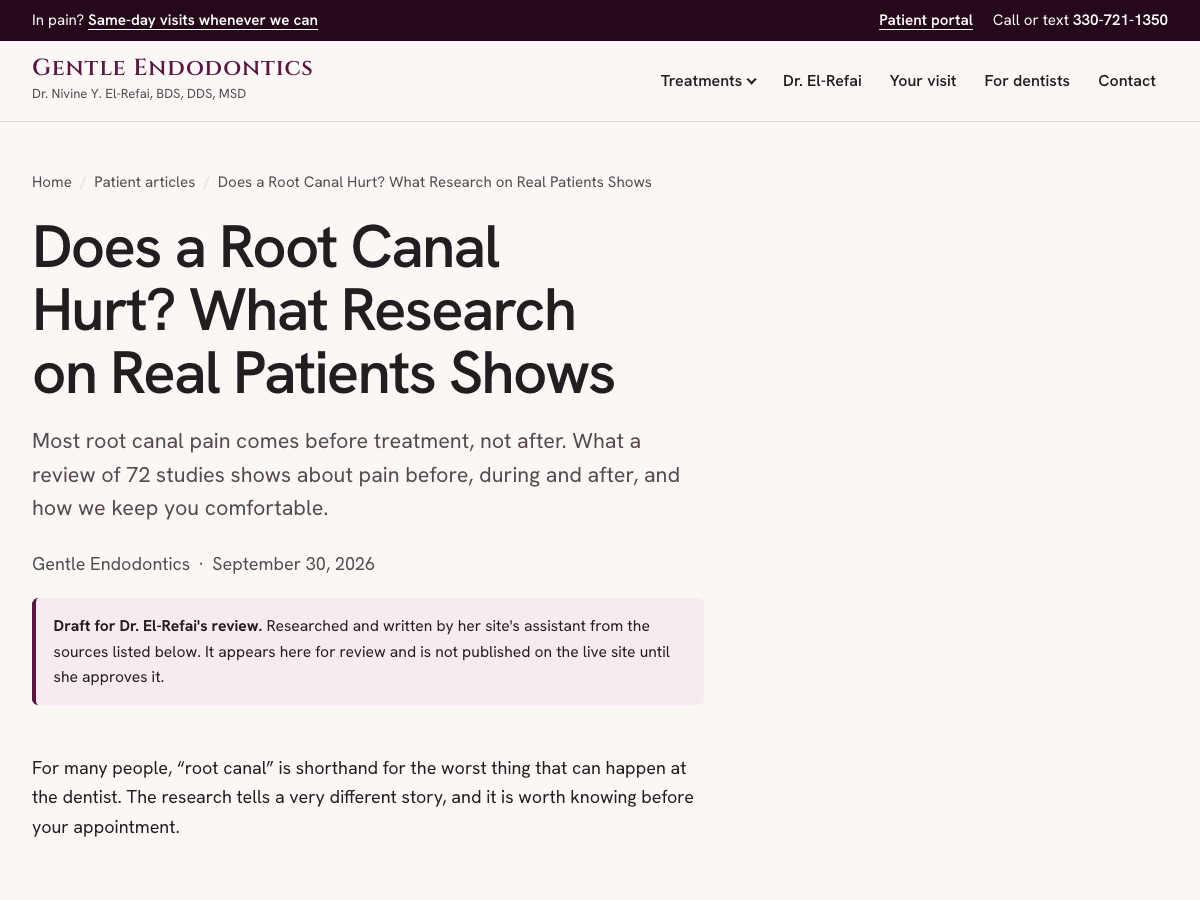
Your site drafts, you approve
- Research. Your site's assistant rechecks what local patients are searching each month, and once the site is live, what they searched to find you.
- Draft. It picks the next question, reads the research, and writes the article with every claim cited.
- You review. The draft appears on the preview site, clearly marked. You approve it, ask for changes, or turn the topic down.
- Publish. Only approved articles go live, carrying "Reviewed by Dr. Nivine Y. El-Refai".
Twelve articles are drafted and waiting for you now, including the four topics from our October 5 call, with six more topics researched and queued.
Beyond the articles
- A sedation page. "Sedation root canal near me" and "IV sedation root canal near me" are ready-to-book local searches, and you offer IV sedation with a board-certified dentist anesthesiologist. In our searches, no nearby endodontic practice clearly targets them.
- One listing to check. WebMD and the Better Business Bureau show "Northcoast Endodontic Specialists" at your suite. If that name is out of date, correcting it keeps every directory consistent, which local search rewards.
- Search Console at launch, so the next round of research uses your real search data.